
El primer déjà vu - Daniel Calabrese / 丹尼尔·卡拉布雷塞
Un caballo sobre la pampa y un árbol. // Un caballo que se mece / con la ternura de un barco. // Un caballo de miel / y dos riendas duras. // Qué. ¿No viste la muerte, / cómo cabalgaba? /
El primer déjà vu
Daniel Calabrese / 丹尼尔·卡拉布雷塞
第一次的既视感
草原上的一匹马和一棵树。
一匹摇曳的马
带着船儿般的温柔。
一匹蜂蜜色的马
以及两根坚硬的缰绳。
什么?你没见过死亡
是如何疾驰而过的?
一匹木马
和一棵断裂的树
在荒野漫游。
然后我记起了自己曾经的状态:
茫然,摇晃,悲伤,流淌。
什么?你没见过死亡
是如何疾驰而过的?
[翻译 张志]
The First Déja Vu
A horse on the pampas and a tree.
A horse swaying
with boat tenderness.
A honey horse
and two stiff reins.
What? Didn’t you see death?
How it galloped?
A wooden horse
and a tree split wandering
through wastelands.
Then I remembered what I was like:
absent, swayed, sad, liquid.
What? Didn’t you see death?
How it galloped?
[Translated by Katherine M. Hedeen]
El primer déjà vu
Un caballo sobre la pampa y un árbol.
Un caballo que se mece
con la ternura de un barco.
Un caballo de miel
y dos riendas duras.
Qué. ¿No viste la muerte,
cómo cabalgaba?
Un caballo de madera
y un árbol partido vagando
por tierras inútiles.
Y recordé cómo fui:
ausente, mecido, triste, líquido.
Qué. ¿No viste la muerte,
cómo cabalgaba?
*
奇观
这是一天的日程
将巨石搬动。
它很重,
胜过一头耕牛
一条盛满水的口袋。
一眼史前的空洞,
一面漆黑的明镜
简直要将世界吞入腹中。
这是一天的劳动
将巨石举过头顶
轻轻放在路中
让自行车队停止骑行,
让背景音乐停止发声,
让二号公路瘫痪
当红色动脉发出指令。
当一切都已停滞
那巨石阻止它们前行,
当卓越善良的前辈停止了传承,
自然与表象之间的爱
不再延续,
于是,要做的事情
就是再将这块巨石搬动,
再将它举过头顶,用疲惫不堪的眼睛,
将它葬在此地,葬入虚无,
葬进封存冷漠的湖里,
床铺在那里吱呀作响,电视在那里闪光,
马达在那里轰响,
葡萄酒滴入阳光,记忆和悲哀的对话
在腐烂并沉没,和那巨石一起
跌入彻底的灭亡。
[赵振江译]
Wonder
Today’s work involves
moving a stone from here to there.
It’s a heavy rock,
more than an ox,
more than a sack full of rain.
It’s a prehistoric hole
a black mirror
close to swallowing the world.
Today’s work involves
lifting that stone and letting
it gently drop in the middle of the road
to block off the bikers and
background music,
to block off Route 2
when the red arteries say so.
And when everything’s at a standstill,
all slowed down by the stone,
illustrious, saintly generations stopped up,
stopped up too the love between things natural
and revealed,
then the work
will involve taking it away from that place,
lifting the stone once more, with tired eyes,
and burying it somewhere, in the nothingness,
in the lake of hidebound indifference
where beds creak, TVs glow,
engines shine,
wine flows into light,
memory and sad conversations rotting
and soon sinking, along with the stone,
into the most complete extinction.
[Translated by Katherine M. Hedeen]
Prodigio
El trabajo de este día consiste
en llevar una piedra de aquí para allá.
Es una roca muy pesada,
más que un buey,
más que una bolsa cargada de lluvia.
Es un agujero prehistórico,
un espejo negro
a punto de tragarse el mundo.
El trabajo de este día consiste
en alzar esa piedra y depositarla
suavemente en el medio del camino
para que se detengan los ciclistas,
se detenga la música de fondo,
se detenga la Ruta Dos
a la hora señalada por las arterias rojas.
Y cuando todo esté detenido,
entorpecido por la piedra,
detenidas las generaciones ilustradas y piadosas,
detenido el amor entre las cosas naturales
y las cosas manifiestas,
el trabajo, entonces,
consistirá en sacarla de ese lugar,
levantar la piedra nuevamente, con los ojos cansados,
y enterrarla por ahí, en la nada,
en ese lago de cerrada indiferencia
donde cruje la cama, alumbra el televisor,
brillan los motores,
cae el vino adentro de la luz,
se pudren la memoria y las conversaciones tristes,
y se hunden, con la piedra,
en la más completa extinción.
*
听不见的噪音
我们留下麦克风
在荒凉森林里彻夜开着
次日当我们回放录音
听到的却只是漫长的寂静
犹如金属质地的风
从寸草不生的星球吹来
我们加速回放
而后听到了低语声
似乎两棵树促膝谈心
话音从田野
飘向2号公路
我们把回放速度调得更快
那些声音也随之蔓延滋长
像树与树的耳语越来越响亮
当你将头贴向木头
能听得真真切切
偶尔出现“镜子”
或“蜃楼”之类的词汇
语调缓慢,还夹杂着
“十字架” “横档”
和“十字路口”
[赵振江译]
The Soundless Songs
We left the microphone going
all night in an abandoned forest.
The next day we played back the recording
but couldn’t hear anything but a whoosh.
It was like the metallic wind
of a sterile planet.
We played it back faster.
Then low noises began to emerge
like a conversation between two trees
spreading out over the country
toward Route 2.
We played it back even faster
and the sounds swelled
like the conversation between two trees growing
and if you listen close
with your head up against the wood
at some point it seems like the creaking
of words like “mirror,” “mirage,”
and then words so slowly like
“rood,” “crossbeam”
“wayside cross.”
[Translated by Katherine M. Hedeen]
Sonidos inaudibles
Dejamos andar el micrófono
toda la noche en un bosque desolado.
Al otro día hicimos correr la grabación
pero no se oyó más que un soplido.
Era como el viento metálico
de un planeta estéril.
La hicimos correr más rápido.
Aparecieron entonces los ruidos bajos
como si una conversación entre dos árboles
se expandiera desde el campo
hacia la Ruta Dos.
La hicimos correr más rápido aún
y los sonidos crecieron
como la conversación de dos árboles que crecen
y que si uno escucha bien,
con la cabeza apoyada en la madera,
en algún momento parecen crujir
palabras como «espejo», «espejismo»,
y muy lentamente palabras como
«cruces», «crucetas»,
«humilladero».
*
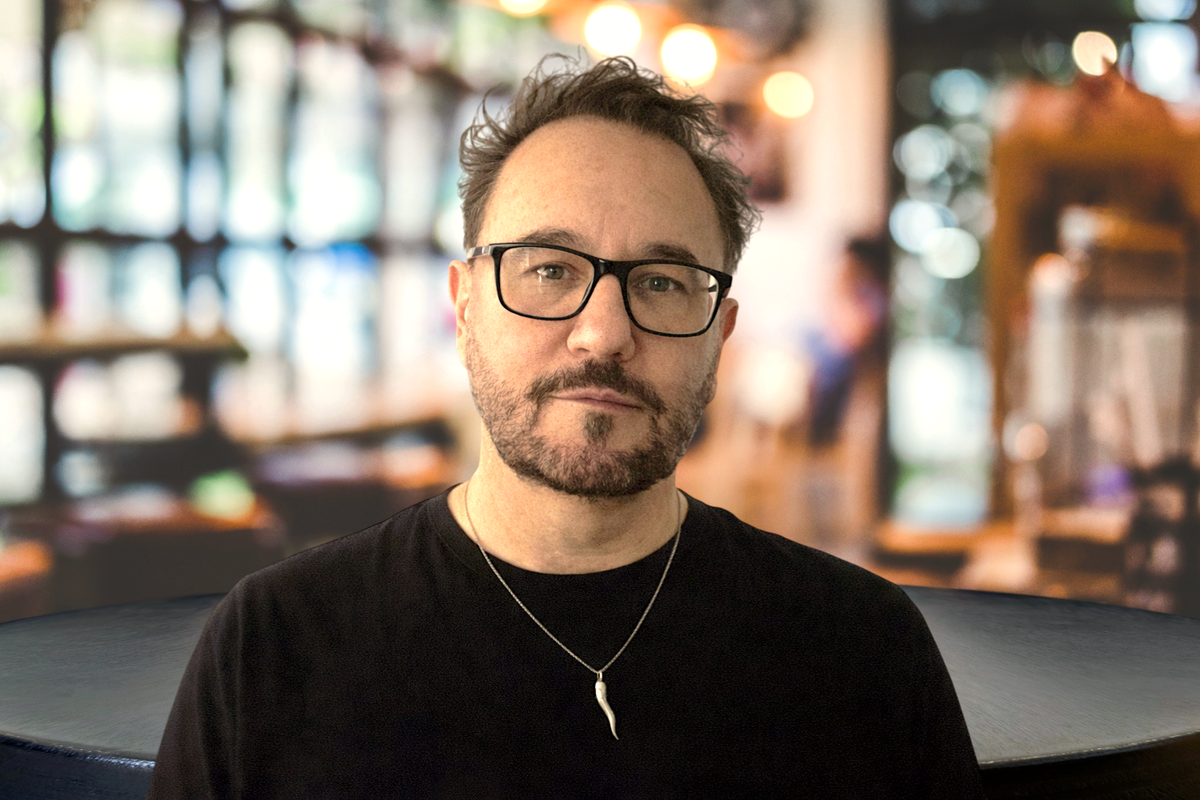
丹尼尔·卡拉布雷塞(Daniel Calabrese),阿根廷诗人,出生于布宜诺斯艾利斯省多洛雷斯市,自1991年起定居于智利圣地亚哥。他的首部诗集《流浪的面孔》荣获阿根廷阿方斯娜·斯托尔尼奖(1990年)。随后出版了《未来灰烬》(1994年)、《日行》(1997年)和《氧化剂》(2001年),后者获得了布宜诺斯艾利斯国家艺术基金会的奖项。其著作《二号路线》在评论界产生了广泛的影响,荣获智利《书评》奖(2013年),并由马德里维索尔出版社出版(2017年),劳尔·祖里塔撰写序言。意大利语版本荣获“卡马约尔国际最佳外国作品奖”(五部最佳外国作品之一)。他的最新著作是《等待模式》(2022年),基于他在马岛战争期间从军的经历。他的最近的诗集和个人选集《万物之天》,已在十余个国家发表。其部分作品已被翻译成意大利语、英语、法语、葡萄牙语、罗马尼亚语、希腊语、保加利亚语、汉语和日语。他是拉丁美洲诗歌杂志《Ærea》的创始人兼编辑,以及维森特·胡伊多布罗基金会国际理事会的成员。
Daniel Calabrese is an Argentine poet born in Dolores, Buenos Aires province, who has lived in Santiago de Chile, since 1991. His first book, La faz errante [The Wandering Face], won the Alfonsina Storni Prize (1990) in Argentina. It was followed by Futura ceniza [Future Ash] (1994), Singladuras [Day’s run] (1997), and Oxidario [Oxidary] (2001), which received an award from the National Fund for the Arts in Buenos Aires. His book Ruta Dos, which had a wide critical impact, won the Revista de Libros Prize in Chile (2013) and was published in the Visor Collection of Madrid (2017) with a prologue by Raúl Zurita. The Italian version was nominated for the Premio Camaiore Internazionale among the five best foreign works. His latest book is Compás de espera [Measure of Waiting] (2022), based on his experience as a soldier during the Falklands War. His poetry collections and personal anthologies, most recently Un cielo para las cosas [A Sky for Things], have been published in more than ten countries. Some of his work has been translated into Italian, English, French, Portuguese, Romanian, Greek, Bulgarian, Chinese, and Japanese. He is the founder and editor of Ærea. Revista Hispanoamericana de poesía [Ærea. Latin American Poetry Magazine], and a member of the International Council of the Vicente Huidobro Foundation.
Daniel Calabrese es un poeta argentino nacido en Dolores, provincia de Buenos Aires, que reside en Santiago de Chile desde 1991. Su primer libro, La faz errante, obtuvo el Premio Alfonsina Storni (1990) en Argentina. Le siguieron Futura ceniza (1994), Singladuras (1997) y Oxidario (2001), premiado por el Fondo Nacional de las Artes en Buenos Aires. Su libro Ruta Dos, de amplia repercusión crítica, obtuvo el Premio Revista de Libros en Chile (2013) y se publicó en la Colección Visor de Madrid (2017) con prólogo de Raúl Zurita. La versión italiana fue nominada al Premio Camaiore Internazionale entre las cinco mejores obras extranjeras. Su último libro es Compás de espera (2022), basado en su experiencia como soldado durante la Guerra de las Malvinas En 2025, la Universidad de Extremadura (España) publicó Intemperies o Una piedra colgando de las nubes (volumen didáctico sobre su poesía y la de Víctor Rodríguez Nuñez). Su obra dispersa está publicada en las principales revistas dedicadas a la poesía hispanoamericana y es un autor frecuente en festivales internacionales y otros escenarios. Parte de su obra ha sido traducida al italiano, portugués, inglés, rumano, francés, búlgaro, griego, chino y japonés. Es fundador y director de Ærea. Revista Hispanoamericana de Poesía. www.daniel-calabrese.com