
Jorge Boccanera - Despeñadero / Cliff
Es extraño cargar tanto peso y sentirse vacío. / Hay Sísifos que empujan cada día la sombra de una piedra. /
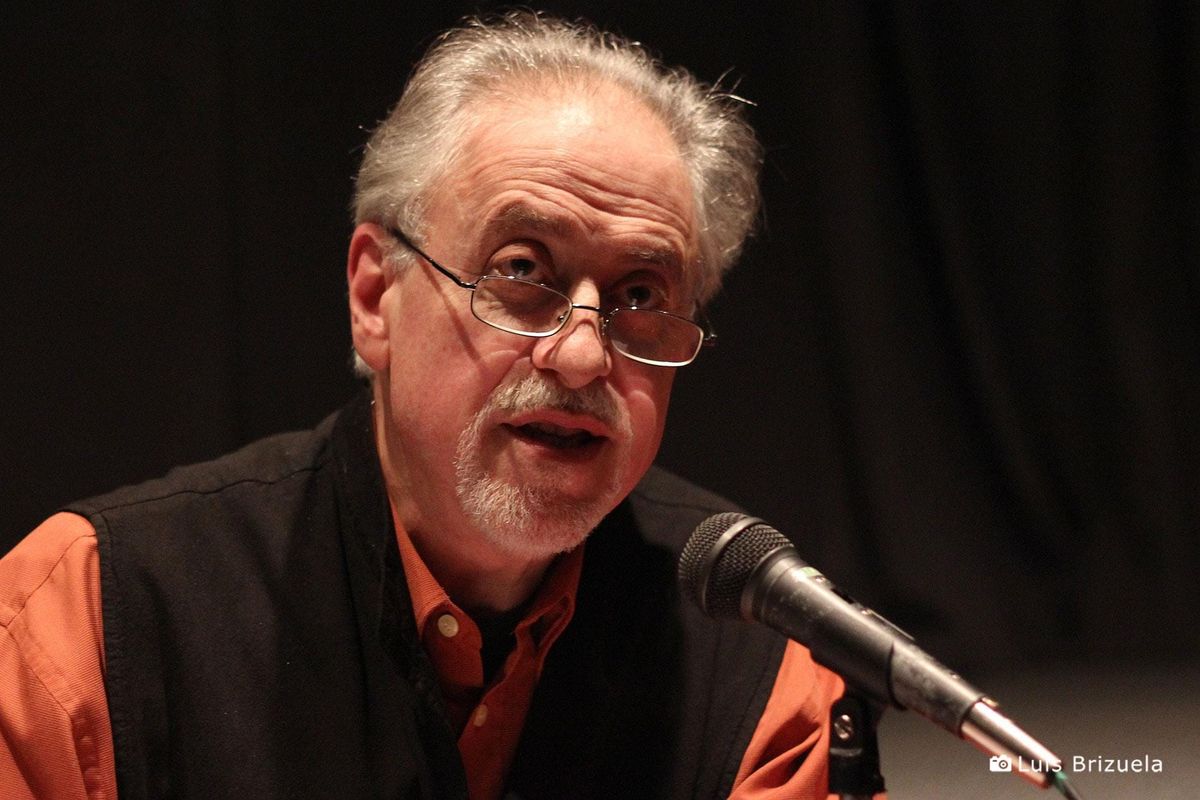
Jorge Boccanera
Despeñadero / Cliff
Translated by Katherine M. Hedeen and Víctor Rodríguez Núñez
Báscula
a Camilo Retana
Los platos del balancín están en guerra.
Si uno escala un macizo el otro va hacia el fondo,
si uno elige volar el otro repta.
La balanza y sus dos brazos enemigos, ni siquiera se miran
¿Cuánto pesa el pesar?
¿Qué Dios podría aportar siquiera un gramo para el equilibrio?
Las piedras del agobio en un platillo; en el otro un gran
ramo de luz.
Y en la misma romana una bolsa de lágrimas y un sueño
por llegar.
La barra horizontal tiene dos platos, ¿trabajan?
¿para quién?
Un mosquerío de preguntas va ensuciando la sala,
en medio de la sala una mesa, al centro de la mesa una báscula,
en uno de sus platos aquelarre de sombras, hijos rotos, pirañas
a granel, costales de aire ciego.
En el extremo opuesto aguarda una bandeja.
¿Qué cosa podría dar alguna paridad entre el amor y el odio?
Hay que poner el corazón en el plato vacío.
Scale
to Camilo Retana
The pans hanging from the beam are at war.
If one goes up, the other sinks to the bottom,
if one chooses to fly, the other crawls.
The scales and their opposing arms. They can’t even look at each other.
How much does sorrow weigh?
What God could lend a single gram to balance it?
Stones of burden on one pan, a great bouquet of light
on the other.
And on the same steelyard a sack of tears and a dream
to come.
The horizontal bar has two. Do they work?
Who for?
A swarm of questions dirtying the room.
In the middle of the room a table, at the center of the table a scale,
on one of its pans a coven of shadows, broken sons, piranhas
in bulk, bags of blind air.
On the opposite end a tray waiting.
What could even out love and hate?
We must place our hearts there, on the empty pan.
*
Cielo roto
El cantón de Moravia, al norte de San José,
Costa Rica, es nombrado por algunos de
sus pobladores como “cielo roto”. Designa
así una zona de entrada de los vientos alisios
con aguaceros estridentes.
Madriguera de lluvias donde el agua no cae, el agua
se suicida
Goterones descabezados por aquí, despanzurrados por allá
vociferan lo que se derrumba por dentro.
Son los aguaceros del dolor que en una infancia líquida vieron
crecer retoños del diluvio, naufragios de entrecasa y fotos enterradas
en el agua.
Yo vivo en Cielo Roto donde anida el relámpago
–grito afilado, grifo violado–
donde los tejedores del silencio remiendan las plegarias
que se guardan en un cuento vacío.
¿No hay un grito que grite: “¡amaina de una vez!?”.
Solo un dios inclemente que con su furia estruja un pañuelo
empapado de culpa sobre nuestras cabezas.
Música de calaca tabletea sobre el techo de cinc.
Estoy solo en mi casa.
Estoy rodeado.
Broken Sky
The canton of Moravia, north of San José,
Costa Rica, is called “Broken Sky” by some
of its inhabitants. This name designates
an area where the trade winds bring
torrential downpours.
Den of rains where water does not fall, water commits
suicide.
Big raindrops, beheaded here, disemboweled there
proclaim what collapses within.
They are the downpours of pain in a liquid childhood that saw
the sprouts of deluge grow, the ordinary shipwrecks, and pictures
buried in water.
I live in Broken Sky where lightning bolts nest
–sharpened cry, violated tap–
where the silence weavers mend pleas
kept in an empty tale.
Is there a cry to cry out: “Let up for Christ’s sake!”?
Just an inclement god furiously wringing out a cloth
soaked with guilt over our heads.
Skull music rattling on the zinc roof.
I am alone in my house.
I am surrounded.
*
Despeñadero
a Daniel Calabrese
¿Cómo lograremos quitar, madre,
la piedra que cerca tu puerta?
YANNIS RITSOS
Es extraño cargar tanto peso y sentirse vacío.
Hay Sísifos que empujan cada día la sombra de una piedra.
Dentro de las palabras habitan lágrimas de polvo,
podría ser peligroso hurgar las vísceras de alguna lágrima,
la nostalgia carga sus voces ciegas.
En su torrente,
la memoria también va arriando piedras.
Cada noche es un despeñadero que se abisma en la lengua.
Son piedras que tropiezan dos veces con la misma vida.
Cliff
to Daniel Calabrese
How might we, mother, remove the
stone surrounding your door?
YANNIS RITSOS
It is strange to bear so much weight and feel empty.
There’s more than one Sisyphus to push the shadow of a stone each day.
Dusty tears dwell within the words,
it might be dangerous to probe the guts of a tear,
nostalgia suffers its blind voices.
In its torrent,
memory also loosens stones.
Each night is a cliff sinking deep into language.
They are stones stumbling twice over the same life.
*
Engarce
a Silvio Rodríguez
La mano que lleva un niño de la mano, lleva una llave,
enciende un fuego al tacto, un sueño y una noche que niega la hondonada,
una en la otra se aprende a caminar, a respirar.
Y va enlazada a un ramo.
La mano que ha plantado una mano en la suya siente
hundirse un aliento en el agua del día, da confianza de
manos abrazadas, como el lugar donde se abre lo por decir,
lo por llegar. Y el que conduce es conducido.
La mano que lleva a un niño de la mano da un cuenco y un
viento en ese cuenco y un viaje en ese viento donde estallan
banderas de colores y bestias fabulosas comparten un camino
que comienza en un sitio de manos abrazadas.
La mano que lleva un niño de la mano fue a la cita en un lugar
de robustas memorias donde la mano que traga saliva era
recuperada de la soledad. Una en la otra.
La mano que lleva un niño de la mano no retrocede nunca.
Link
to Silvio Rodríguez
The hand holding the hand of a child brings with it a key,
lights a fire with its touch, a dream and a night denying the hollow, one
hand in the other, learning to walk, to breathe.
The key is bound to a branch.
The hand placing a hand in its own feels
a breath sink into the water of the day, inspires the confidence of
hands embraced, like the place where what is yet to be said,
what is yet to come, unfolds. The one who leads is led.
The hand holding a child’s hand offers up a bowl and a
wind in that bowl and a journey in that wind where
colorful flags burst and fabulous beasts share a path
that begins in a site of hands embraced.
The hand holding the hand of a child went to the encounter in a place
of robust memories where the hand swallowing saliva was
rescued from loneliness. One in the other.
The hand holding the hand of a child never retreats.
*
Palma real (LXVI)
a Jeannette
Vos conmigo.
En el aire brilla el salto de un jaguar.
Llueve y es plumaje amarillo lo que cae, escarcha
verde, lenguas rojas.
El bosque se calza su armadura de niebla y un árbol
gigantesco tiembla en la breve telaraña.
Caminamos una alfombra de insectos de ceniza y
sílabas quebradas.
Yo con vos.
La mariposa parpadea.
Unos labios se intuyen bajo el barro volcánico.
Al interior de la palabra “caoba”, todo se hace silencio.
La selva te respira, la respiras. Chicharras en la boca
del tigre y piedras aulladoras,
enormes abejones que bailan en una sola pata.
El bosque es filigrana, bruma de la quebrada, helecho
y bien arriba el roce del musgo con las nubes.
Una voz: “Deja sólo tus huellas”
Otra más: “Escucha, huele, mira”.
Agua que trastabilla, guacamayas en un aire de
asombro.
La lluvia duplicando al coyote, al zorro hediondo,
los monos cariblanca y al pisote.
Vos conmigo.
Va a aparearse el toledo y el corazón de todos se
detiene.
Los senderos acercan lo distante. Laberintos hundidos
bajo los lodazales.
Yo con vos.
El tiempo transpira 400 plumajes diferentes, 100 mamíferos extraños
uno al otro, los imposibles rostros
de la orquídea. Y fumarolas. Y relámpagos.
Taladrando el follaje caen goterones despanzurrados.
Es remoto y futuro lo que veo.
Vos conmigo.
En este gran caldero,
la cuchara de Dios mezcla la selva.
Royal Palm (LXVI)
to Jeannette
You with me.
In the air shines a jaguar leap.
It’s raining and what falls is yellow feathers, green
frost, red tongues.
The forest dons its misty armor and a gigantic
tree trembles in the fleeting spiderweb.
We walk on a carpet of ash insects and
broken syllables.
Me with you.
The butterfly blinks.
Glimpses of lips beneath the volcanic mud.
Inside the word “mahogany,” everything turns to silence.
The jungle breathes you, you breathe it. Cicadas in the mouth
of the tiger and howling stones,
enormous bumblebees dancing on just one leg.
The forest is filigree, ravine mist, fern,
and high above the brushing of moss against the clouds.
A voice: “Leave only your footsteps.”
Another: “Listen, smell, look.”
Water stumbling, macaws in an air of
wonder.
Rain replicating coyote, skunk,
white-faced monkeys, and coati.
You with me.
The long-tailed manakin is about to mate and everyone’s heart
stops.
Paths bring distance closer. Labyrinths sunken
beneath the mudflats.
Me with you.
Time sweats 400 different feathers, 100 mammals
unknown to each other, the impossible faces
of the orchid. And fumaroles. And lightning bolts.
Drilling through the foliage bursting raindrops fall.
What I see is remote and future.
You with me.
In this great cauldron,
God’s spoon stirring the jungle.
Jorge Boccanera (Argentina, 1952). Poeta y periodista. Entre sus libros figuran Polvo para morder, Sordomuda, Bestias en un hotel de paso, Palma Real y Monólogo del Necio. Algunos de ellos traducidos al francés, italiano y griego. Su antología Tráfico / Estiba reúne su producción editada entre 1974 y 2015. Obtuvo, entre otros premios, el Casa de las Américas (Cuba), el Internacional de Poesía Camaiore (Italia) y en México el premio Internacional Ramón López Velarde. Coordinó la Cátedra Abierta de Poesía Latinoamericana en la Universidad Nacional de San Martín (Buenos Aires, Argentina).
Jorge Boccanera (Argentina, 1952) is a poet and journalist. His books include Polvo para morder, Sordomuda, Bestias en un hotel de paso, Palma Real, and Monólogo del Necio. Some of his poetry has been translated into French, Italian, and Greek. The anthology Tráfico / Estiba collects his published work from 1974 to 2015. Among other awards, he has received the Casa de las Américas Prize (Cuba), the Camaiore International Poetry Prize (Italy), and the Ramón López Velarde International Prize (Mexico). He coordinated the Endowed Chair in Latin American Poetry at the National University of San Martín (Buenos Aires, Argentina).